
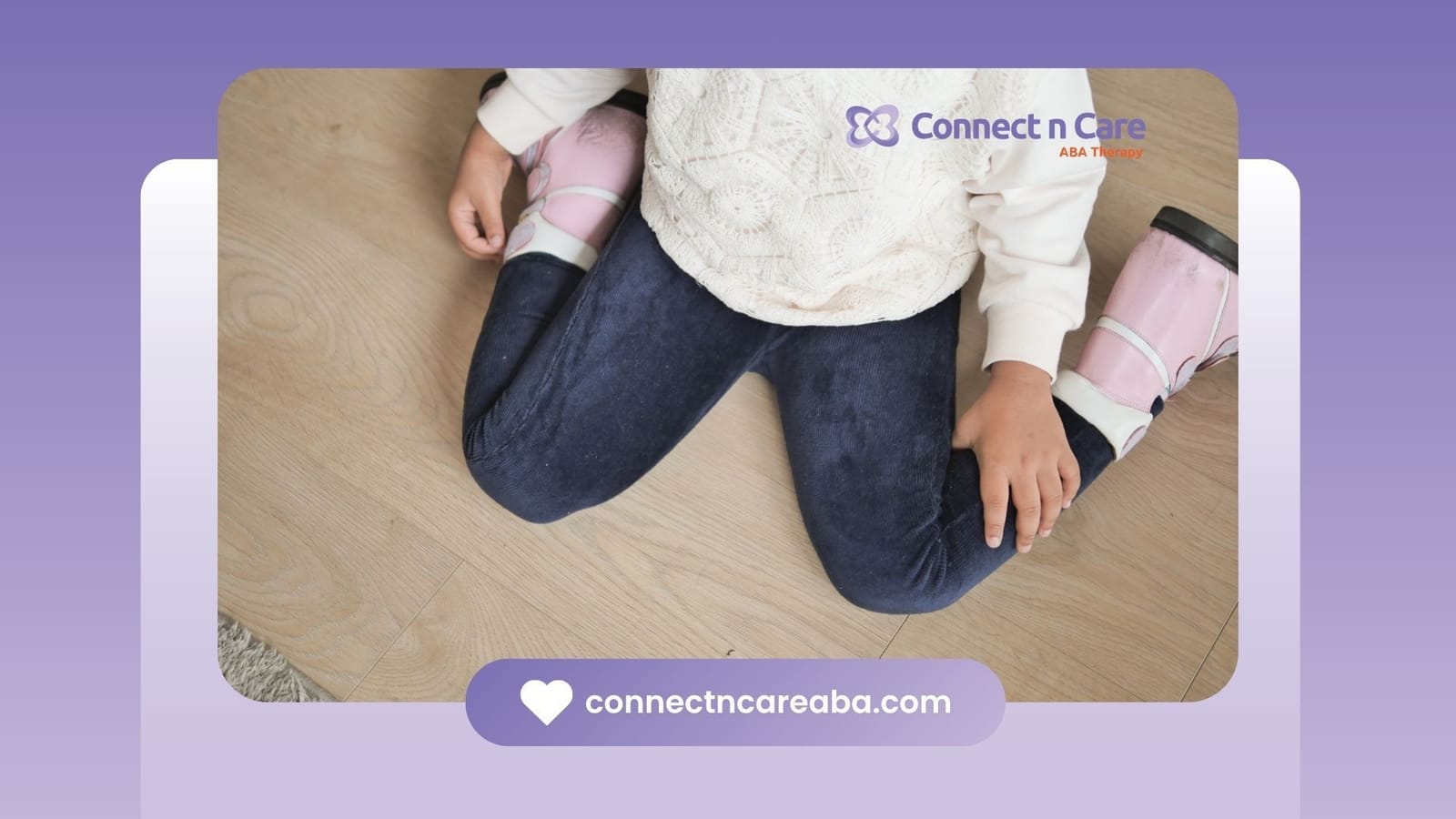
When an autistic child folds into a W on the floor, perches on the edge of a chair, sits on their feet, or twists sideways instead of sitting "properly," the position is almost never defiance and almost never random. It is the body solving a problem.
For many autistic children, sitting is a sensory and physical task before it is a social one. The way a child arranges their body in a chair or on the floor is usually an unconscious effort to feel stable, grounded, and regulated. Once you see what the posture is doing, the same behaviour that looked odd starts to look like competent self-management.
If your child is young and sitting is one of several things you have been noticing, that pattern is worth looking at properly rather than piece by piece. Early intervention ABA is where sensory, motor and communication differences get untangled together, and you can contact our team to describe what you are seeing before committing to anything.
This guide covers the sensory and physical reasons behind unusual sitting, what specific positions tend to mean, what the research actually says about W-sitting, and how to build environments that work with a child's nervous system instead of against it.
Why Sitting Is a Sensory Task
Sitting requires more than muscles. It requires the brain to know where the body is in space, to feel steady against gravity, and to filter out competing sensory information long enough to focus. For autistic children, one or more of those processes often runs differently.
Three systems do most of the work.
The Proprioceptive System
Proprioception is the body's internal sense of where its parts are. Receptors in the joints and muscles send constant updates: my elbow is bent, my back is against something firm. When that feedback is weaker or harder to interpret, the body can feel vague and hard to locate, and the nervous system pushes back.
The fix the body lands on is almost always deep pressure. Sitting on the feet pushes the soles into the floor. Tucking knees under the chest compresses the joints. Pressing the back hard into a wall gives the spine something to feel. Every one of those positions is the body asking for more information about where it is.
It is the same impulse behind seeking tight hugs, wedging into couch cushions, or chewing on a shirt collar. Sitting is just one more place the need shows up.
The Vestibular System
The vestibular system, in the inner ear, tracks balance and motion. When it is under-responsive, a child needs more movement than usual to feel oriented, so they rock, swing their legs, or spin in their chair. The movement is not a distraction from focus. It is often what makes focus possible.
When the system is over-responsive, the opposite happens. Feeling unbalanced is alarming. These children sit rigidly, refuse chairs that swivel, and freeze when their feet leave the floor.
The Tactile System
For many autistic children the tactile system runs hot. The texture of a chair, a seam pressing into the back of a thigh, the cold of a metal stool, a scratchy uniform: any of these can register as genuinely unpleasant.
A child with tactile defensiveness may perch to minimise surface contact, sit on their hands to insulate from the seat, or prefer the floor because it is predictable. Adults often read this as picky. It is a sensory system reporting that the input is too much. Our piece on tactile sensitivity covers what helps.
Muscle Tone and Postural Effort
Layered on top of all of this, lower muscle tone is something we see frequently in the children we work with. When the core has to work harder to hold the body upright, twenty or thirty minutes of conventional sitting is genuinely tiring.
When the core cannot carry the load, the body looks for shortcuts: a wider base, a surface to lean on, a position that lets the skeleton rather than the muscles do the holding. That is why so many alternative postures share one feature. They require less active effort.
Put it together and unusual sitting stops looking unusual. It looks like a body that has worked out, without being taught, how to get the input and support it needs.
Common Sitting Positions and What They May Mean
None of these is inherently good or bad. What matters is whether it helps the child participate.
W-Sitting
In W-sitting, a child sits on their bottom with knees bent and feet out to either side of the hips. It offers an extremely wide base of support, which lets a child with low tone stay upright with almost no effort, freeing attention for play.
The standard warning about W-sitting is not well supported. A systematic review published in 2024 searched five databases and concluded there is no scientific evidence to advise against W-sitting in children and no association with hip dysplasia, and that muscular activation is the same regardless of the sitting position chosen. The review also notes why the position is common in three to six year olds: increased femoral anteversion at that age makes it comfortable, and it naturally regresses with growth, which is why adults rarely W-sit. The International Hip Dysplasia Institute reaches the same conclusion, stating that studies show W-sitting does not harm developing hips.
This matters for autistic children specifically, because the anti-W-sitting advice circulating in schools and on social media leads adults to redirect a position that may be doing real regulatory work, on the basis of a risk that does not appear to exist.
Two honest caveats. Children with a known condition affecting hip development are a different conversation, and that belongs with their physician or physical therapist. And exclusive use of any single position means less practice with the others, so offering variety is reasonable. Habitual W-sitting is better understood as a signal about core strength and postural effort than as a cause of harm.
Cross-Legged and Its Variations
Cross-legged sitting creates a stable base and frees the hands. The crossed legs deliver light proprioceptive pressure across the hips and thighs, which is organising for a child seeking that input, and the clear physical boundary acts like a frame telling the body where it ends.
Some children adopt asymmetrical variations, one leg crossed and one tucked under. That usually reflects a search for a specific pressure point the body has found and keeps returning to.
Perching on the Edge of a Chair
Perching gets misread as restlessness. More often it is a child keeping their muscles actively engaged. Sitting all the way back removes proprioceptive feedback; perching restores it by making the core, legs and feet do continuous low-level work. It also keeps the child feeling ready to move, which is regulating for a nervous system that does not tolerate stillness well.
Children who perch often look fidgety to teachers while concentrating harder than they would slumped back.
Sitting on the Floor
The floor offers a firm, predictable surface, easy position changes, and no unpredictable textures pressing into the back. For a child managing sensory load, it is often the calmer choice, and it lets them shift fluidly between postures as different tasks demand.
Sitting on the Feet, Kneeling, or Curling Up
These usually point to proprioceptive seeking. Sitting on the feet presses the soles into the floor, kneeling compresses the knees and shins, and curling delivers pressure across the whole body.
A child who consistently curls knees to chest may also be using the position to block competing input, creating a small predictable envelope when the environment outside feels overwhelming. If that is happening often, our piece on autism overstimulation covers what usually sits behind it.
Hooking Ankles Around Chair Legs
Easy to miss, because the rest of the child looks like they are sitting conventionally. The hooked ankles are doing anchor work, adding stability and proprioceptive feedback, usually because the chair is too tall for their feet to rest flat.
Schools that switch to correctly sized chairs often see this disappear. The child was not fidgeting. They were stabilising.
Lying Down for Tabletop Work
Lying on the stomach to colour or read is partly proprioceptive, since the chest and forearms press into the floor, and partly a workaround for fatigue, since no postural muscles are required. It is a reasonable working position for plenty of tasks even if it does not look like school.
When Seating Choices Are Doing Real Regulatory Work
A child changing positions often, or strongly preferring an unusual one, is information rather than a problem. Some patterns that suggest the choices are load-bearing:
They settle into focused activity more easily when allowed their preferred position. A child who cannot sit through one story on a regular chair but sits through three on a beanbag is telling you something.
They unravel over time when required to sit conventionally. Watch the trajectory across a thirty-minute task. If it starts fine and deteriorates, that is accumulated postural or sensory fatigue rather than motivation.
They seek out specific surfaces when overwhelmed. Many autistic children develop a regulation spot the way adults develop a favourite chair. Honouring it costs nothing.
They lean, slump, or prop themselves up heavily. A child who repeatedly puts their head on the desk is often tired in a specific muscular way.
They alternate between bursts of movement and unusually still sitting. The movement is often how the focus gets earned. It is the regulation, not the failure of it.
It is worth noticing what travels alongside. Children seeking proprioceptive input through posture usually seek it elsewhere too: crashing into couches, chewing sleeves, pressing fingers into palms. Same family of behaviour, same underlying need.
How to Build Better Seating Options
The goal is not correct sitting. It is enough options that a child can find one that fits the task. A child with three good choices will almost always choose better than a child told to sit one specific way.
Alternative seating. Wobble cushions and air discs sit on any regular chair and allow small movements. They are cheap, portable, and often the single most useful adjustment. Wobble stools tilt without sliding, for children who need movement but find a full ball too unstable. Bean bags and floor cushions deliver deep pressure for tasks where the child needs calming rather than activating. Floor desks let a child work cross-legged or kneeling at a surface.
Therapy ball seating, with a caveat. Stability balls are the most-studied option and the evidence is genuinely mixed. A study in the American Journal of Occupational Therapy found increases in in-seat behaviour and legible word productivity for students with ADHD seated on therapy balls, with both teachers and students preferring them, and Schilling and Schwartz reported similar classroom benefits for young autistic children in 2004. But a later review in the Journal of Behavioral Education notes that while social validity stays high, findings on effectiveness are mixed, with some studies finding no benefit or worse on-task behaviour. Treat it as worth trying for a specific child rather than a reliable fix.
A footrest. A folded blanket or small box under the feet of a child whose feet do not reach the floor often eliminates chair-leg wrapping entirely. It is the cheapest change on this list and frequently the most effective.
Movement before it is needed. Two minutes of jumping, animal walks, or heavy work like carrying a stack of books gives the proprioceptive and vestibular systems what they are asking for. The common mistake is waiting until a child is visibly dysregulated, by which point a short break cannot reset anything. Schedule movement like any other part of the routine.
Reduce the sensory load around the seat. Background noise, harsh lighting and visual clutter all contribute to how exhausting sitting feels. A softer chair cover, looser clothing, or a quieter corner can turn an intolerable seat into a workable one.
Build core strength through play. Bear crawls, crab walks, climbing, swinging and obstacle courses build postural control without feeling like exercise. Pushing, pulling and carrying give the double benefit of strength and organising input.
Vary the position rather than banning one. Offer cross-legged for one activity and side-sitting for another. Children learn to vary posture by experiencing more options, not by being corrected out of their default.
At home, let it go. Some families notice their child sits fine at school then drops straight to the floor at home. That is not a behaviour problem. It is a child releasing postural effort they have been holding all day, and home needs to be somewhere they can.
Getting Seating Supports Written In: North Carolina and Virginia
Most of the friction happens at school, and parents often approach flexible seating as a favour to ask for. It does not have to be.
Under federal law, a wobble cushion, a footrest or an alternative chair can count as low-tech assistive technology. US Department of Education guidance is explicit that each time an IEP team develops, reviews, or revises a child's IEP, the team must consider whether the child requires assistive technology devices and services, and the definition covers any item, including something bought off the shelf, used to increase or improve a child's functional capabilities. That applies to schools in both North Carolina and Virginia. Documented in the IEP, the seating becomes the district's responsibility rather than one teacher's discretion. If your child receives school-based ABA therapy, this is exactly the kind of environmental adjustment the BCBA, teacher and family can align on.
On the therapy side, North Carolina Medicaid covers ABA under Clinical Coverage Policy 8F, with services delivered under a prior authorised treatment plan carrying measurable goals, reviewed at least every six months by a Licensed Qualified Autism Service Provider. That six-month review is the scheduled moment to raise seating and postural regulation rather than handling it informally.
In Virginia, Item 291.WW.2 of the 2026 Appropriation Act directs the Department of Medical Assistance Services to impose a 20-hour per week cumulative limit on ABA, with DMAS saying in a July 2026 bulletin that it will announce the effective date after federal approval. Capped hours are an argument for handling sensory and postural supports through the school and an occupational therapist where possible, and reserving ABA hours for what only ABA can do.
When to Seek an Evaluation
Most unusual sitting is adaptive. A few patterns warrant a closer look.
Sitting is painful, exhausting, or avoided even with supportive alternatives. A child who reports discomfort, cries when asked to sit, or melts down predictably around seated tasks deserves assessment. Pain in any position should always be taken seriously.
Posture concerns paired with other motor signs. Toe walking, frequent falling, difficulty with stairs, trouble with handwriting, or difficulty with dressing often share underlying causes and benefit from coordinated support.
Sitting difficulties are interfering with school, meals, or family routines. The threshold is not whether a child can technically sit. It is whether sitting costs so much energy that other things suffer.
Exclusive use of one position with strong resistance to any other. Not because the position is harmful, but because a child who cannot transition between floor positions may have an underlying strength or motor planning issue worth addressing.
Genuine distress rather than preference. Sensory distress and behavioural resistance look similar from outside and call for very different responses.
An occupational therapist can assess how sensory systems, muscle tone and motor coordination are working together and build a plan that addresses causes rather than surface behaviour. That usually includes observing how the child moves, hands-on evaluation of tone and joint mobility, and questions about daily routines. Our overview of sensory processing evaluations in North Carolina covers what that process looks like locally.
For some families occupational therapy runs alongside ABA. For others it stands on its own or pairs with physical therapy. Either way it shifts the question from why will they not sit still to what does this body actually need.
Conclusion
Unusual sitting positions in autistic children are almost always the body compensating for how proprioceptive, vestibular or tactile input is being processed, often alongside the extra postural effort that lower muscle tone demands. W-sitting gives a wide base for very little effort, perching keeps the core engaged, floor sitting offers predictability, and hooked ankles usually mean the chair is too tall. The long-standing warning that W-sitting damages hips is not supported by the current review evidence, which changes how adults should respond to it. The useful approach is to offer several good seating options rather than enforce one, build in movement before a child needs it, reduce the sensory load around the seat, and reserve concern for pain, distress, motor red flags, or sitting difficulties that are costing a child their participation. Where a support genuinely helps at school, it can be written into the IEP as assistive technology rather than left to chance.
Ready to Talk It Through?
Connect n Care ABA provides early intervention ABA, ABA parent training, and school-based ABA therapy to families across North Carolina and Virginia.
If you are noticing these patterns and want help working out what your child's body is asking for, contact our team and we will listen first and help you decide on the right next step.
SOURCES:
- https://www.nimh.nih.gov/health/topics/autism-spectrum-disorders-asd
- https://pmc.ncbi.nlm.nih.gov/articles/PMC11723520/
- https://hipdysplasia.org/w-sitting-and-hip-development/
- https://pubmed.ncbi.nlm.nih.gov/14527115/
- https://link.springer.com/article/10.1007/s10864-020-09412-3
- https://sites.ed.gov/idea/files/Myths-and-Facts-Surrounding-Assistive-Technology-Devices-01-22-2024.pdf
- https://medicaid.ncdhhs.gov/8f-research-based-behavioral-health-treatment-rb-bht-autism-spectrum-disorder-asd
- https://vamedicaid.dmas.virginia.gov/bulletin/applied-behavior-analysis-aba-policy-changes